
The Housing Proposal
HOUSING. LOCATION. RESPONSIBILITY.
The need for housing does not establish the suitability of a site.
Where Things Stand
The Pre-Development Agreement does not constitute development approval, a completed property sale or authorization to begin construction.
Project status reviewed November 19, 2026.
The Town of Waterbury is pursuing the potential development of multifamily housing on State-owned land formerly occupied by Stanley and Wasson Halls.
In August 2025, the Town issued a Request for Qualifications (RFQ) seeking a developer for the property. DEW Properties, LLC was the sole respondent.
The Town subsequently elected to pursue an exclusive agreement with DEW rather than reopen the solicitation. Portions of the developer's submission, including conceptual development details, were redacted from the publicly released document.
On June 23, 2026, the Town and DEW completed the execution of a Pre-Development Agreement establishing a 12-month due diligence period to evaluate project feasibility.
Despite subsequent requests for disclosure, portions of DEW's RFQ submission remain redacted in the publicly available document, even after the execution of the exclusive Pre-Development Agreement.
2.29
Acres
Proposed subdivision size
The Project at a Glance
90
Housing units
Preliminary 2025 concept
$400k
Purchase price
Town's purchase option
12
Months
Due diligence period
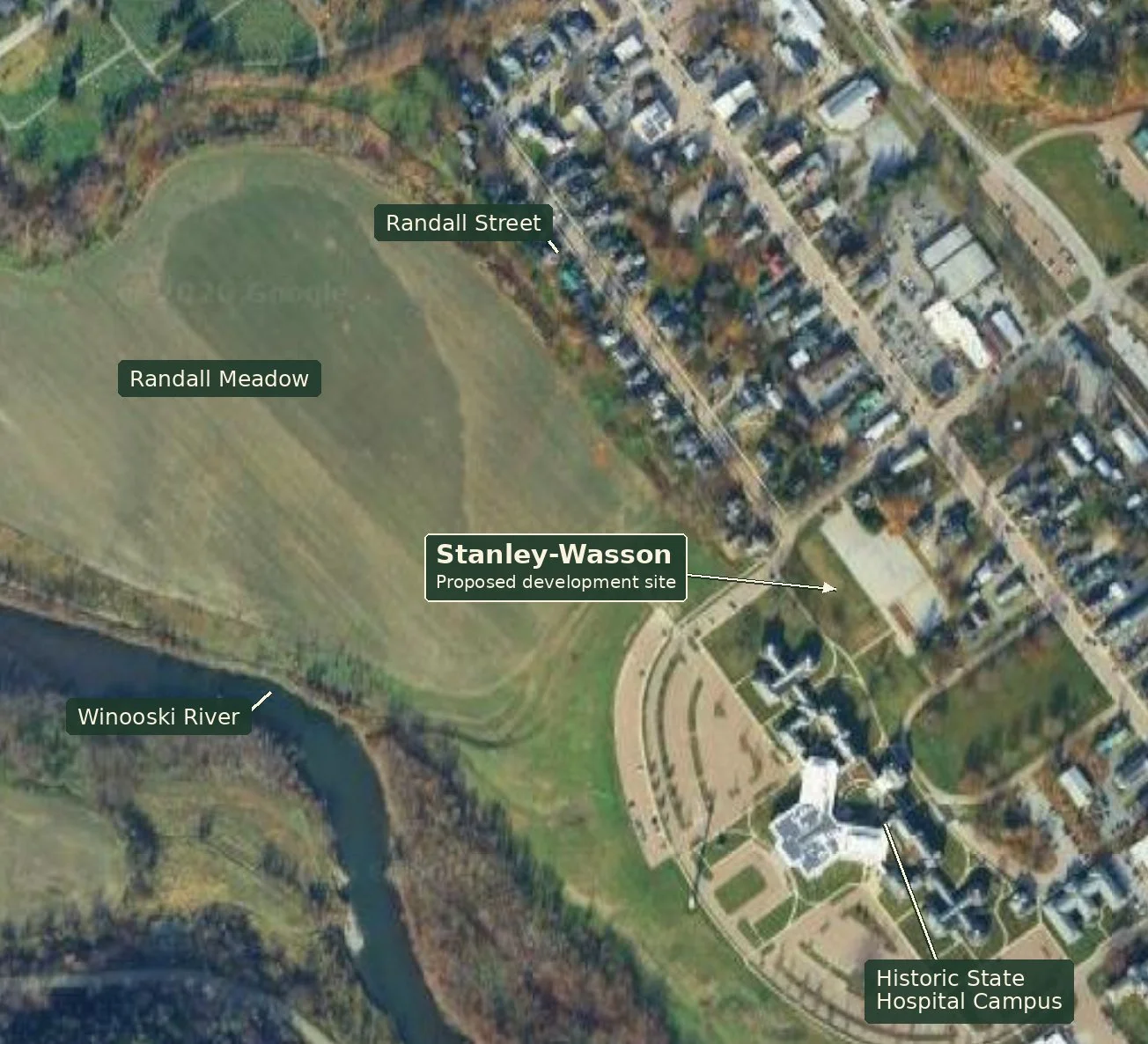
Source: Google maps @2026
Beyond the Numbers
Housing density is only one measure of a property's development potential.
The Town's October 2025 presentation identified the following development parameters under the Campus zoning district:
60-foot building height limit
20-foot exterior lot line setbacks
No general lot coverage limit
However, acreage and zoning parameters alone do not establish the development capacity of a property.
At Stanley-Wasson, development must also account for:
Floodwater displacement and compensatory flood storage
Parking, driveways and vehicle circulation
Safe ingress and egress, including during flood events
Emergency vehicle access and resident evacuation
Existing utilities and easements
Water and wastewater infrastructure capacity
Existing inflow and infiltration (I/I) issues within the neighborhood's sewer system
Stormwater management and reported sewer and stormwater backups into neighboring basements
Historic preservation considerations
Compatibility with the surrounding residential neighborhood
These considerations are particularly significant given the property's location within a federally designated Special Flood Hazard Area.
The question is not simply how many housing units can fit on this property, but whether the land can responsibly support them.
Ownership & Legislative Authority
Before Development: Creating the Parcel
The former Stanley-Wasson property remains part of the larger State-owned Waterbury State Office Complex, an existing Act 250-permitted tract.
On January 29, 2024, the State submitted Act 250 application 5W0431-6A to subdivide approximately 2.28 acres for conveyance to the Town of Waterbury. The application expressly stated that no development was proposed at that time.
On February 12, 2024, the District 5 Coordinator notified the State that its application was incomplete.
More than two years later, on July 1, 2026, the District 5 Environmental Commission issued a Notice of Intent to Dismiss, citing an extended period of inactivity and an outstanding State Wastewater System and Potable Water Supply Permit.
The State was given 30 days to respond. The Waterbury Selectboard, Waterbury Planning Commission and Central Vermont Regional Planning Commission were formally notified.
As of November 19, 2026, completion of the subdivision has not been verified.
Authorization to sell, approval to subdivide and approval to develop are three distinct actions.
Supporting Documents:
Act 250 Application 5W0431-6A — Notice of Intent to Dismiss, July 1, 2026
Act 69 (H.493) — Section 22(b), page 30
Is Waterbury Required to Purchase the Property?
No.
In 2023, the Vermont Legislature enacted Act 69 (H.493), authorizing the Commissioner of Buildings and General Services to subdivide and convey the Stanley-Wasson property specifically to the Town of Waterbury, subject to stated conditions.
The legislation provides for rescission of that authority if its specified conditions are not met. Unlike other property dispositions addressed within the same legislation, it contains no provision authorizing the sale of Stanley-Wasson to an alternative purchaser.
During the October 6, 2025 Selectboard meeting, discussion suggested that declining to purchase the property could result in its sale directly to a private developer.
At the October 20, 2025 Selectboard meeting, the Town Manager acknowledged that he anticipated the State would return to the Legislature seeking new authorization for such a sale.
The possibility of future legislative action should not be confused with existing legislative authority.
Waterbury holds an option to purchase, not an obligation to purchase.
The suggestion that the property will be sold to another developer if Waterbury chooses not to purchase it is speculative and is not supported by the existing legislative authorization.
Waterbury has a choice.
The Pre-Development Agreement
Understanding the commitments.
The agreement establishes exclusive due diligence rights for DEW Properties.
Market-rate housing is envisioned first, followed by a phase potentially involving senior, workforce or affordable housing.
Neither the final housing mix nor the delivery of affordable housing is guaranteed.
DEW Properties
Funds its own due diligence.
Assesses financial feasibility and potential impacts on neighboring properties during flooding.
Considers compensatory flood storage.
Funds and obtains development permits, excluding the subdivision approvals.
Meets monthly with Town representatives and provides written updates every other month.
These commitments are drawn from Sections 4–10, 14 and 17 of the executed agreement
Town of Waterbury
Assists with financing, grants and tax credits, including administering awards.
Requests Planning Commission consideration of zoning changes if needed for feasibility.
Funds road, sidewalk and crosswalk improvements it elects to undertake.
Explores tax-increment financing through the Community Housing and Infrastructure Program (CHIP).
Discusses funding options for relocating the existing storm drainage line, if necessary.
Pays its own project-related expenses, including legal and engineering costs.
Important Milestones
June 23, 2026
PDA fully executed.
July 1, 2026
Act 250 Notice of Intent to Dismiss issued for the subdivision application dated Jan. 2024, which noted no development was proposed.
October 2026
Four-month milestone: DEW to propose additional project milestones.
December 1, 2026
Town to advise DEW of subdivision status and anticipated closing.
December 31, 2026
Purchase option deadline, unless extended.
June 2027
Anticipated conclusion of due diligence, subject to written extension.
Contractual milestones and documented events. Inclusion does not confirm completion of outstanding obligations.
The developer's responsibility for due diligence costs does not mean the project carries no financial obligations for the Town.
The extent of potential public investment deserves to be understood before further commitments are made.
Questions That Remain
Housing demand is only one part of the equation.
01
Flood Resilience & Public Safety
Flood storage, displacement, safe access and evacuation.
How would development affect existing flood storage, floodwater displacement and neighboring properties?
Even if residential buildings are elevated, how will safe ingress, egress, emergency access and resident evacuation be ensured when surrounding streets are inundated?
04
Infrastructure & Existing Conditions
I/I, sewer backups, stormwater and utility capacity.
Have the neighborhood's existing inflow and infiltration (I/I) issues and reported sewer and stormwater backups into residential basements been adequately assessed?
Can existing infrastructure accommodate additional residential demand, and what improvements may be necessary?
02
Historic Preservation
Historic significance, landscape, setting and preservation review.
How will the proposed property transfer and subsequent development address the site's historical significance, its location within designated historic districts and the integrity of the surrounding historic landscape?
05
Financial Responsibility
Public expenditures, financing and long-term obligations.
What public expenditures, infrastructure improvements, financing arrangements and long-term municipal obligations could result from this development?
Who would bear those costs, and what financial risks could the community assume?
03
Neighborhood Compatibility
Building scale, traffic, privacy and quality of life.
How would the height, mass and density of the proposed development affect the established residential neighborhood?
How will traffic, parking, lighting, privacy and neighborhood character be addressed?
06
Transparency & Accountability
Public records, regulatory approvals and informed decision-making.
What regulatory approvals remain outstanding?
When will the community have access to the market study, technical assessments, written project updates and other information upon which future decisions will be based?